








Gigamon Inline V Series vs. UCT‑V on AWS: Which Is Right for Your Use Case?
 Sriram Shanmugam
Gigamon offers multiple ways to acquire traffic in AWS, and two of the most powerful are Inline V Series and GigaVUE® Universal Cloud Tap (UCT‑V). Both feed traffic into V Series nodes and your security and observability tools, but they do it in very different ways — with different implications for visibility, risk, latency, and operations.
This blog breaks down how each model works, the key trade‑offs, and practical guidance on when to choose one over the other — or when to use them together.
Conceptual Overview
Inline V Series (AWS)
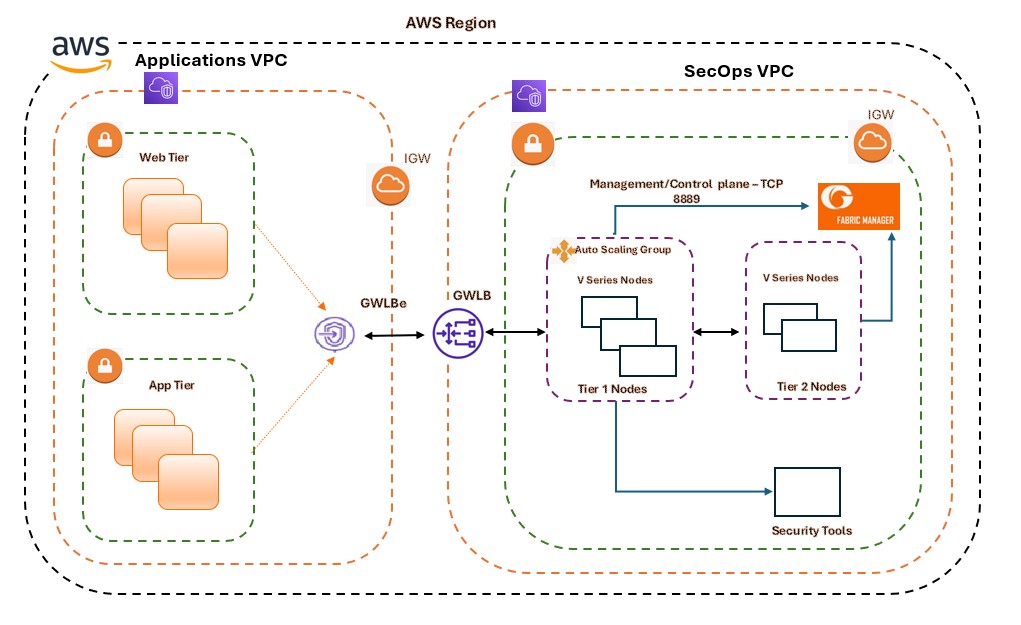
Inline V Series is an agentless, inline acquisition model built around AWS Gateway Load Balancer (GWLB). Selected flows are steered through Inline V Series nodes via GWLB endpoints, so every protected packet must traverse the inline inspection chain.
Key characteristics:
- Traffic acquisition: Inline in the data path via GWLB and GWLB endpoints; packets must pass through Inline V Series.
- Deployment components: GWLB, GWLB endpoints, Inline V Series Auto Scaling Group (ASG), dedicated appliance VPC/subnets, AWS Monitoring Domain (traffic acquisition = inline), Monitoring Session (inline).
- Workload footprint: Fully agentless — nothing installed on EC2 instances; redirection happens at VPC/GWLB/routing layer.
- Typical coverage: Best for North–South flows that can be routed through GWLB (internet ingress/egress, centralized inspection between VPCs, etc.).
- Primary strength: Enables inline enforcement (NGFW/IPS/inline inspection) with low‑latency processing and GWLB‑managed failover.
GigaVUE Universal Cloud Tap (UCT‑V)
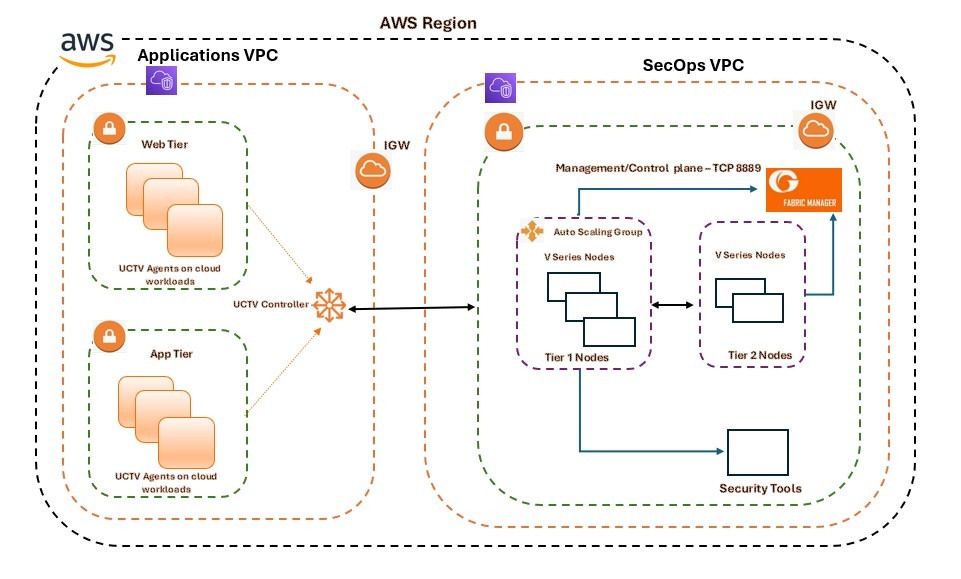
UCT‑V is an agent‑based mirroring model. A lightweight UCT‑V agent on each monitored VM mirrors traffic from the VM interface into a tunnel (VXLAN/L2GRE/secure tunnel) toward V Series nodes.
Key characteristics:
- Traffic acquisition: Agent-based mirroring from within each VM’s interface; mirrored traffic is tunnelled to V Series nodes.
- Deployment components: UCT‑V agents on VMs, one or more UCT‑V Controllers, V Series nodes, AWS Monitoring Domain (traffic acquisition = UCT‑V).
- Workload footprint: Agent on each monitored VM; requires package deployment, lifecycle management, and sometimes security policy exceptions.
- Typical coverage: Strong inside‑VPC and East–West visibility, with per‑VM granularity and selective tapping of specific workloads.
- Primary strength: Deep visibility without putting production traffic inline — failures typically impact visibility, not application reachability.
Feature Comparison
Features | Inline V Series (AWS) | UCT-V on AWS |
Traffic acquisition model | Inline in the data path via GWLB and GWLB endpoints; packets must traverse Inline V Series nodes. | Agent-based mirroring from each VM’s interface, traffic is tunneled to V Series nodes. |
Deployment components | GWLB, GWLB endpoints, Inline V Series ASG, appliance VPC/subnets, monitoring domain (inline), monitoring session (inline). | UCT-V agents on VMs, one or more UCT-V Controllers, V Series nodes, monitoring domain (traffic acquisition = UCT-V). |
Workload footprint | Agentless, all redirection happens via routing/GWLB. | Agent on each monitored VM, install/upgrade/config per OS and image. |
Typical coverage | Primarily North–South. | Primarily East–West. |
Use of cloud-native features | Deeply tied to AWS GWLB: GENEVE encapsulation, health checks, target failover, LB-managed distribution. | Uses tunnels (VXLAN, L2GRE, or secure tunnel) from UCT-V to V Series; less dependent on AWS LBs for acquisition. |
Performance/latency | Designed for low-latency inline processing; GWLB distributes flows and handles target failover, but every protected flow sees additional hops. | Adds mirror and tunnel overhead, but production flows are not inline gated by V Series; failures usually mean loss of visibility, not traffic. |
Traffic enforcement | Suitable for inline enforcement (NGFW, IPS, WAF chains) all selected flows must pass through the inspection path. | Primarily observe/monitor, production path is unaffected, so enforcement is indirect (via tools feeding policy back elsewhere). |
Failure behavior | If an Inline V Series node fails, GWLB health checks can drain/rebalance or bypass based on design. | If UCT-V or its tunnel fails, that VM’s visibility is impacted; application traffic continues over its normal path. |
Operational complexity | Heavier on network engineering (GWLB design, endpoints, route tables, dedicated VPC, troubleshooting inline chains). | Heavier on endpoint/agent lifecycle (deploy, upgrade, policy management, version compatibility between UCT-V, Controller, V Series, GigaVUE-FM). |
Policy/platform constraints | Good fit where no agents on servers is a hard requirement. | Constrained by organization policies around agents and OS support. |
Traffic that is hard to see | Purely intra-VPC East–West flows that never touch GWLB unless you redesign routing. | Agentless resources and some managed services/serverless where you can’t run a UCT-V agent. |
Summary
- Inline V Series is an agentless, GWLB‑based inline model optimized for North–South traffic and enforcement use cases, at the cost of more routing/network complexity and an inline dependency.
- UCT‑V is an agent‑based mirroring model that provides deep East–West and per‑VM visibility with low risk to production traffic, at the cost of agent lifecycle management and controller operations.
- The strongest designs typically combine both, using Inline V Series where inline enforcement and centralized chokepoints make sense, and UCT‑V where granular, low‑risk visibility into workloads is the priority.
By mapping these trade‑offs to your organization’s risk tolerance, operational model, and visibility gaps, you can choose the right acquisition mix and evolve over time as your AWS footprint and security posture mature.

CONTINUE THE DISCUSSION
People are talking about this in the Gigamon Community’s Hybrid/Public Cloud group.
Share your thoughts today
