






The AI Gold Rush Has Created a Massive Security Blind Spot and Most Enterprises Don’t See It Yet
 Sandi Meyer
Generative and agentic AI is moving faster than enterprise security teams can adapt. But according to a new Omdia report commissioned by Gigamon, the real problem may not be the AI models themselves. It is the explosion of invisible machine-to-machine activity AI is unleashing across enterprise infrastructure.
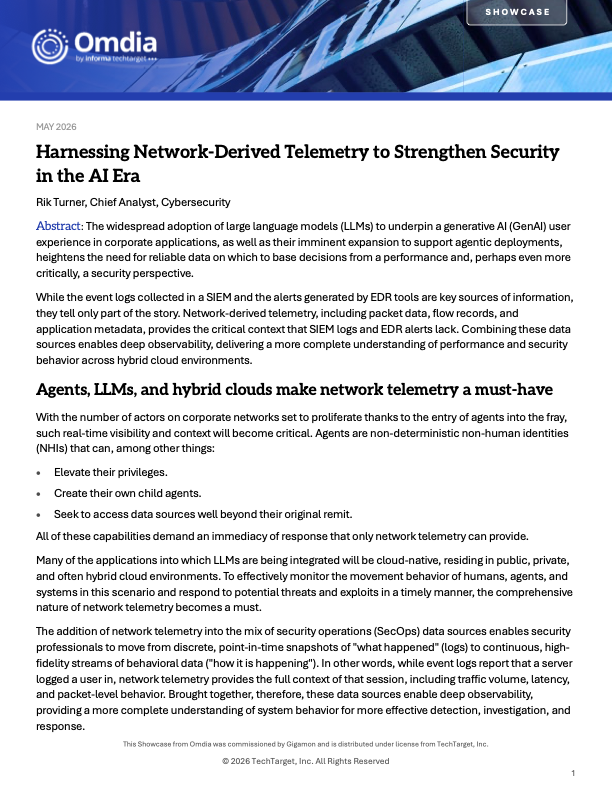
As organizations rush to deploy LLMs, copilots, and agentic AI systems across hybrid cloud environments, traditional security and observability tools are increasingly operating with partial visibility. SIEMs, EDRs, and perimeter defenses still matter, but Omdia argues they are no longer enough on their own. AI workloads are simply exposing how incomplete those signals have always been.
The report’s central message is hard to ignore: network-derived telemetry is becoming foundational infrastructure for the AI era. “Network-derived telemetry… provides the critical context that SIEM logs and EDR alerts lack.”
This message was reinforced in our 2026 Hybrid Cloud Security Survey, where 92 percent of security and IT leaders agree that deep observability is foundational in securing AI deployments.
For years, enterprises relied heavily on event logs and endpoint tools to understand what was happening inside their environments. But AI workloads are changing the rules in real time. Modern applications are distributed across public cloud, private cloud, SaaS, APIs, containers, GPUs, and microservices. The result is an explosion of internal machine-to-machine communications that many existing security architectures were never designed to inspect.
Today, 76 percent of data center traffic is East-West traffic — lateral communications moving internally between services, datasets, and applications. In many environments, the majority of operational activity is now happening in places that traditional perimeter-focused tools were never built to see.
This is where the report cuts through the noise surrounding AI security. The biggest risk may not be AI-generated attacks themselves but rather the lack of visibility into how AI systems behave inside enterprise infrastructure.
Omdia warns that AI agents introduce entirely new operational risks because they are “non-deterministic, non-human identities” capable of elevating privileges, creating child agents, and accessing unauthorized data sources. That creates a difficult challenge for security teams attempting to govern autonomous systems at machine speed inside already fragmented environments.
The challenge becomes even more urgent when encryption enters the picture. Nearly 90 percent of cyberthreats are now delivered over encrypted channels, yet decrypting all traffic at scale is increasingly impractical in modern hybrid cloud environments.
This also aligns with our 2026 Hybrid Cloud Security Survey, where 91 percent of security and IT leaders said application metadata is critical to revealing threats within encrypted traffic.
Instead, Omdia argues organizations need intelligent telemetry pipelines capable of extracting high-fidelity metadata and contextual insights without overwhelming security infrastructure or introducing unnecessary operational complexity.
And the implications extend well beyond cybersecurity.
AI workloads can generate unprecedented amounts of network traffic, especially across hybrid and multi-cloud environments. Performance bottlenecks, latency spikes, and application failures increasingly happen inside encrypted East-West traffic flows where traditional monitoring tools struggle to see.
This is where deep observability becomes increasingly important, combining logs, packets, flows, metadata, and AI-driven analytics to create a far more complete operational picture across hybrid cloud environments.
And this is where the Omdia report becomes especially relevant for IT executives.
Many organizations are still treating telemetry as an operational afterthought. Omdia argues that mindset must change. “Telemetry management is strategic and, as such, should be both built in and budgeted for early.”
That is an important shift. Network telemetry is no longer just a networking concern. It is increasingly becoming a resilience and governance issue tied directly to AI operations, cloud risk, cyber readiness, and business continuity.
The broader takeaway from the report is clear: AI is accelerating infrastructure complexity faster than traditional security and observability models can adapt. Organizations that invest early in deep observability and intelligent telemetry pipelines will be better positioned not only to strengthen security, but to manage AI systems with greater operational confidence and resilience.
In the AI era, visibility is quickly becoming a prerequisite for trust.

CONTINUE THE DISCUSSION
People are talking about this in the Gigamon Community’s AI Exchange group.
Share your thoughts today
